Khoury News
Khoury PhD students awarded NSF fellowship for researching the future of AI
How can AI agents collaborate without compromising security? How can AI models help us unravel the secrets of our biological building blocks? Matthew Laws and Kevin Lu are on the hunt for answers.
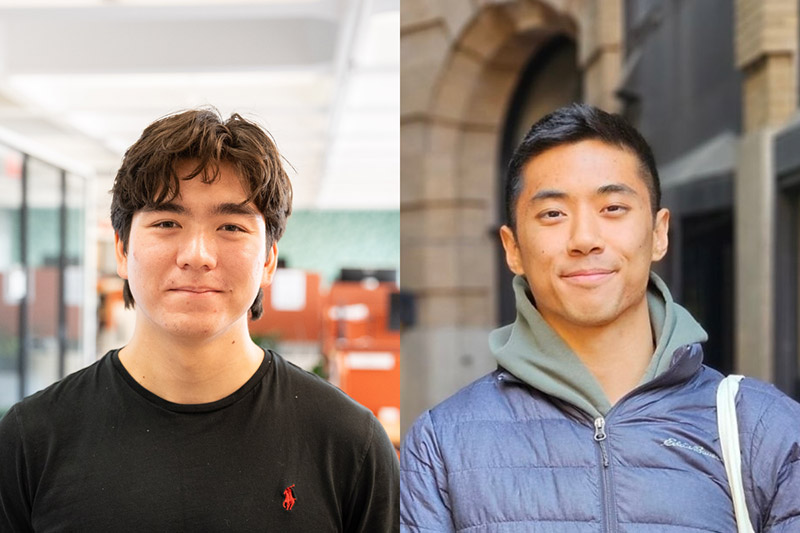
Two Khoury PhD students have been selected for the National Science Foundation (NSF) Graduate Research Fellowship Program, one of the oldest and most competitive fellowships in the country. NSF sorts through thousands of applications annually, providing the winning applicants with funding and resources for their post-undergraduate careers.
During their doctoral studies, awardees Matthew Laws and Kevin Lu are both aiming to answer fundamental questions around AI models and what the future of this technology could look like. Below are overviews of the work they will pursue.
The complexities of AI-based security
Matthew Laws, a computer science graduate from Williams College, began his PhD program at Khoury College in 2025 under Professor Cristina Nita-Rotaru. His research focuses on the growing reliance on AI agents and the security risks that they can create.
Laws explores situations where multiple agents collaborate to solve a shared task, reasons about what new adversarial attacks can come from this collaboration, and provides system-level defenses for preventing such attacks. He has found that when multiple agents are used as security, there are complications in detecting the different techniques each agent is using, making it difficult for the system to function safely overall.
“If you have a bunch of AI agents interacting with each other in an agent ecosystem, then we need to find a way so that agents can’t just do whatever they want without consequences,” Laws said.
As AI infiltrates more industries, there is a growing demand for a better understanding of these models, one that will allow them to function as efficiently and effectively as possible.
“This field is evolving fast. This intersection of security and LLMs … this generation of researchers is among the first people to explore all this,” Laws said.
Using fellowship funding and resources, Laws will continue exploring the security of multi-agent systems, hoping to find an accountability solution that prevents these agents from compromising critical workflows. He believes that as AI seeps into everyday life, it’s up to researchers like him to solve issues with these systems now before they become integrated across the tech sphere.
“I don’t think any one person will solve the AI problem. But I think it is important that people in my field are working towards some kind of solution,” Laws said.
AI to accelerate biological discovery
As an undergraduate at Northeastern, Kevin Lu always knew he wanted to work in research. In his sophomore year, he joined Professor David Bau’s lab, where he began studying how large AI models represent and process information internally. Now, fresh off earning his bachelor’s degree in computer science and mathematics, Lu is continuing at Khoury College as a PhD student, advised by Bau and Assistant Professor Wengong Jin.
Lu’s research sits at the intersection of two worlds: mechanistic interpretability — the study of reverse-engineering trained neural networks into algorithms humans can understand — and AI for biology. He wants to know what protein and cell models have learned about biology, how they use that knowledge, and whether their internal representations can be steered to support scientific discovery and drug design.
“The models we’re building for biology are becoming incredibly powerful, but in many cases we still don’t really know what they’ve learned or how they arrive at their predictions,” Lu says. “I’m interested in whether understanding what’s happening inside them can help us both build better models and learn something new about biology.”
This interest was solidified during a co-op Lu completed as a machine learning researcher at Takeda Pharmaceuticals, where he saw firsthand the difficulty and scale of modern drug discovery.
“The co-op was pretty big for me because it exposed to me how hard drug discovery is,” Lu said. “It showed me how these AI models are actually accelerating drug discovery pipelines and where my role could be in this.”
Back at Northeastern, Lu turned interpretability tools on protein structure prediction models such as AlphaFold, which take a sequence of amino acids and predict the three-dimensional shape the protein folds into. In work released this summer with collaborators at Northeastern and other institutions, he and his co-authors found that these models internally represent biological properties like amino acid charge and structural features, and that they appear to build a protein’s shape in two distinct stages.
For Lu, that work is an early example of a broader possibility. If researchers can understand how biological concepts are represented inside AI systems, they may eventually be able to control models more precisely, predict how proteins and cells behave under different biological conditions, or even uncover patterns in biology that the models have learned but scientists have not yet recognized.
Lu hopes to eventually use interpretable protein and cell models to better understand disease, identify promising therapeutic targets, and help design molecules or proteins that can intervene in disease processes.
Beyond protein structure, Lu plans to study increasingly powerful protein and virtual-cell foundation models, with the long-term goal of turning interpretability into a tool not only to explain AI, but also to turn these models into more reliable tools for biological discovery, drug design, and improving human health.
“I think there’s an opportunity to go beyond asking whether these models are right or wrong,” Lu said. “If they’ve learned meaningful representations of biology, can we understand those representations well enough to use them? And maybe, eventually, can that understanding help us design better therapies or uncover biology that we didn’t already know to look for?”
The Khoury Network: Be in the know
Subscribe now to our monthly newsletter for the latest stories and achievements of our students and faculty