Khoury News
Emergency response, flu data, and campus community: Khoury students awarded Patrick P. Lee Scholarship
By leveraging their CS skills and experience around the topics they find most meaningful, Khoury students George Kressler, Mateo Biggs, and Rachel des Bordes have found ways to give back to their communities.
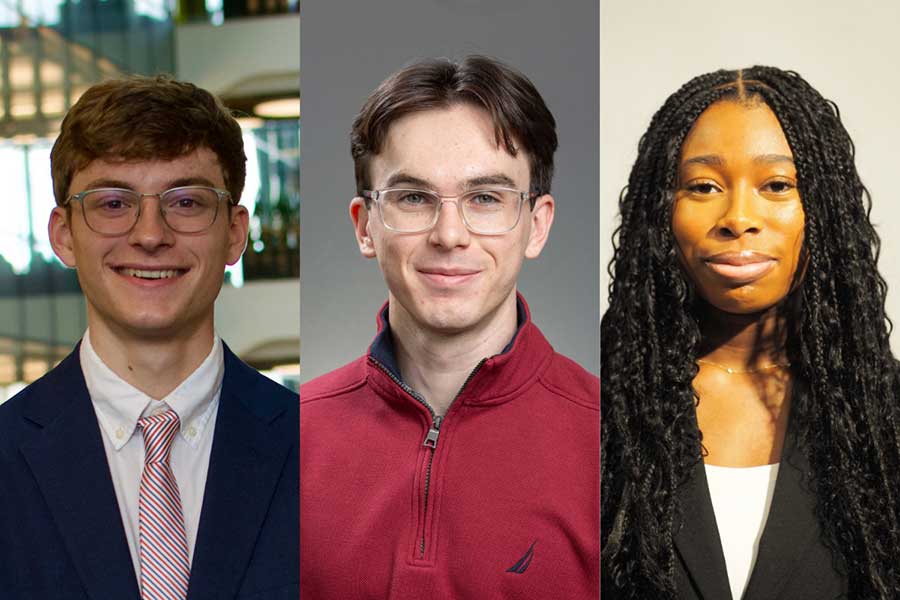
This year, several Khoury students were selected as Patrick P. Lee Scholarship recipients for their commitment to public service and leadership. Established to support students who use their technical skills to make a positive impact in their communities, the scholarship recognizes students who demonstrate innovation and a commitment to giving back. Read more about this year’s recipients below.
George Kressler
At age 14, George Kressler trained with volunteer firemen in Fair Haven, New Jersey, learning how to pop a fire hydrant and refill air bottles. At 17, he responded to his first structure fire, running to the scene by foot.
Around the same time Kressler was becoming a cadet, his older brother broke his neck in a traumatic mountain biking accident. The squad that responded was entirely volunteer, and Kressler joined the EMS squad that same year, even assisting in kickstarting a new EMS program for volunteers under 18.
“That was my first big introductory lesson to health care in the United States,” Kressler said. “The only reason he’s alive is because an EMT and good Samaritans happened to be hiking on the trail, saw him crash, and immediately took action to save his life.”
Now a fourth-year computer science and business administration student with a concentration in health care management and consulting, Kressler responds to hundreds of 911 calls at home each summer.

But he wanted to give back even more, this time by putting his computer science skills — those he learned in classes, taught himself, and applied during his co-op — to work for his EMS squad. He started building a training platform after noticing a gap in the quality of the squad’s narrative reports — EMTs’ written accounts of what happened and the care they provided, which can become important evidence in legal proceedings.
“Each organization has its own preferences over how you write these reports, and it is something that is hard to drill, learn, and teach,” Kressler said. “We found that we were having a lot of quality assurance issues with our narratives.”
The site, which Kressler named Backboard EMS, provides users with a scenario and all the information needed to write a narrative, such as vital signs. After users complete the practice narrative, a large language model, usually ChatGPT 5.6, evaluates the report using a detailed prompt that incorporates state and organizational standards for narratives. It then breaks the evaluation down using a scoring system, offering users a rubric to see how they performed on the report. The system also identifies specific aspects of the narrative that could be adjusted to make it more defensible, should the need arise down the road.
“We’ve seen a dramatic decrease in the quality assurance time since training a little bit with this,” Kressler said, noting that the tool is strictly intended for training purposes and is not meant to be used with real calls.

As squads in his area test the prototype, Kressler hopes to eventually expand its use. He made it as flexible as possible, abstracting almost every feature in the app so that other squads can customize it to fit their own needs.
“All of the other squads are loving it. They’re using it pretty routinely,” he said. “I eventually want to be able to sell this to squads for a near break-even price, depending on how much they’re using it.”
Apart from his work developing the tool, Kressler worked as a co-op at Boston Consulting Group in its Public Sector Management and Operations division. The experience allowed him to leverage his technical knowledge across a range of projects, including helping to run the election process for new partners. Upon graduating in spring 2027, he will return to BCG as a full-time associate in Summit, New Jersey.
Mateo Biggs
Mateo Biggs’ interest in studying flu season began with baseball.
During the summer after his second year at Northeastern, Biggs, now a fourth-year computer science student with a concentration in AI and a minor in public health, noticed Northeastern’s baseball team — ranked 19th in the country — was not performing as well as its hitting and pitching statistics suggested it should.
“I keep an eye on all the teams because I just find them interesting,” Biggs said. “All of these stats reported that Northeastern was a substantially better team, but had a harder time competing against other teams that have a lot of programming, money, and history.”
That discrepancy led Biggs to start building a way to better understand, and eventually predict, college baseball performance. He created an open-source Python package that scrapes season statistics for teams and individual players, then developed an XGBoost prediction model capable of estimating a player’s likelihood of being drafted, potential draft position, and projected signing bonus.

With the goal of eventually predicting the MLB Draft, Biggs applied for the PEAK Summit Fellowship, a 10-week paid undergraduate research program at Northeastern, in the spring of 2026, after completing a fall-cycle co-op as an application developer at State Street in 2025. He continued developing the project while completing a co-op with Chewy, and later, alongside his mentor Eric Gerber, Biggs entered the Carnegie Mellon Sports Analytics research competition for undergrads, where his project is in the second stage of the approval process.
Then, through Research Practicum — a course taught and mentored by Ariel Hamlin that gives students practice refining and applying research skills — Biggs’ work took a turn from baseball to public health. Paired with Khoury Assistant Teaching Professor Deahan Yu, Biggs began applying a similar approach to a different problem: understanding and predicting neighborhood-level influenza outbreaks.
By downloading data from the Boston Public Health Commission, Biggs worked on developing a graph neural network to analyze flu cases in Boston neighborhoods. By overlaying the flu data with demographic census data and climate data, he examined how factors such as income and where people live relate to flu patterns.
There were complications when working with real-world public health data, including how to account for university students who may return home to be vaccinated. Biggs leveraged the AI cluster through Northeastern’s AI Compute Resource to run models more efficiently.
“It’s very easily shown that you getting sick with the flu is predetermined by the money you make or where you live,” he said. “One of the arguments I had for this model was bringing more attention to these kinds of neighborhoods or these kinds of conditions that cause issues, not just with the flu, but with COVID, RSV, and other diseases too.”
Biggs continued developing his flu project through Northeastern’s PEAK Trail Blazer Fellowship. He reached out to the Boston Public Health Commission, Massachusetts Department of Health, and the Public Health Department in Columbus, Ohio — his hometown — to present his work and request additional data.
“The model is very easy to just pick up and move to a different city with comparable public health infrastructure,” Biggs said. “If you have data, just plug it right in.”
Biggs noticed parallels between the baseball and flu projects, despite their very different research questions.
“You have to have the actual right proper data or things cascade into different issues later on,” he said.
That idea is likely to remain central for Biggs. He hopes to continue researching and is interested in looking into the understudied realm of food allergies, something he has dealt with personally. As he looks past his spring 2027 graduation and on toward graduate school — and potentially a PhD — he hopes to investigate more problems through data.
“There’s always ways to incorporate different analytical tools that can help different areas,” he said. “I find it really interesting.”
Rachel des Bordes
Nearing the end of her time at Northeastern, Rachel des Bordes, a fourth-year computer science and economics student, has one piece of advice: Make sure you have a good support system.
For des Bordes, Northeastern’s chapter of ColorStack, a national organization dedicated to supporting Black and Latino students pursuing tech careers, was the place to do so.

“Everything that I’ve gotten is genuinely because of ColorStack,” she said. “I definitely wouldn’t be where I am today without the amazing people who’ve come before me and helped me out. I want to be that for other people coming in.”
Des Bordes joined the chapter in her first year and recalls receiving homework help. Now entering her second year as treasurer, she helps coordinate funding, guest speakers, and workshops. Over time, ColorStack has also given her something she found harder to find elsewhere: a community of peers who share similar experiences.
“Most of the teams in classes I’ve been on, a lot of them are men,” she said. “Everyone in ColorStack is kind of in a similar position. You’re seeing what they’ve done, and it’s just a great place to get advice and build community.”
Alongside ColorStack, des Bordes completed her first co-op remotely at Clear Ballot, where she helped develop an accessible voting machine that was released earlier this year. A key part of her work involved testing the machine to ensure it could run properly for an election. She also helped improve the machine’s accessibility features, such as keyboard input, braille, and headphone support.
Additionally, des Bordes worked at Axon, a technology company that develops tools for public safety and law enforcement. There, she focused on the document viewing experience for two of the company’s products. On the engineering excellence team at Travelers, her second co-op, des Bordes is currently migrating their legacy application to Python.
Across each of these experiences, she said, she is drawn to work that helps others, much like the people who helped her early on.
“I feel like the biggest thing is helping in some way,” she said. “With Clear Ballot and Axon, a lot of that was kind of the intersection of public policy and infrastructure. For Travelers and Liberty, I’m working on teams that are supporting engineers or other employees internally. It’s nice to see the impact that you’re having.”
Outside of her technical co-op experiences, des Bordes has approached her work with the same focus on helping others. As a former front desk attendant and now building manager for the Curry Student Center, des Bordes got to hear directly from students, parents, and other visitors.
“That was me at one point,” des Bordes said, referring to prospective student weekends. “It’s nice to see it full circle.”
The Khoury Network: Be in the know
Subscribe now to our monthly newsletter for the latest stories and achievements of our students and faculty