Khoury News
At Northeastern’s Oakland campus, workshop trains high schoolers in community-focused AI
"Training people to do one specific job is risky," says workshop leader Rasika Bhalerao. "We are now being forced to train people not just to be software engineers, but to become well-rounded people and functioning members of society."
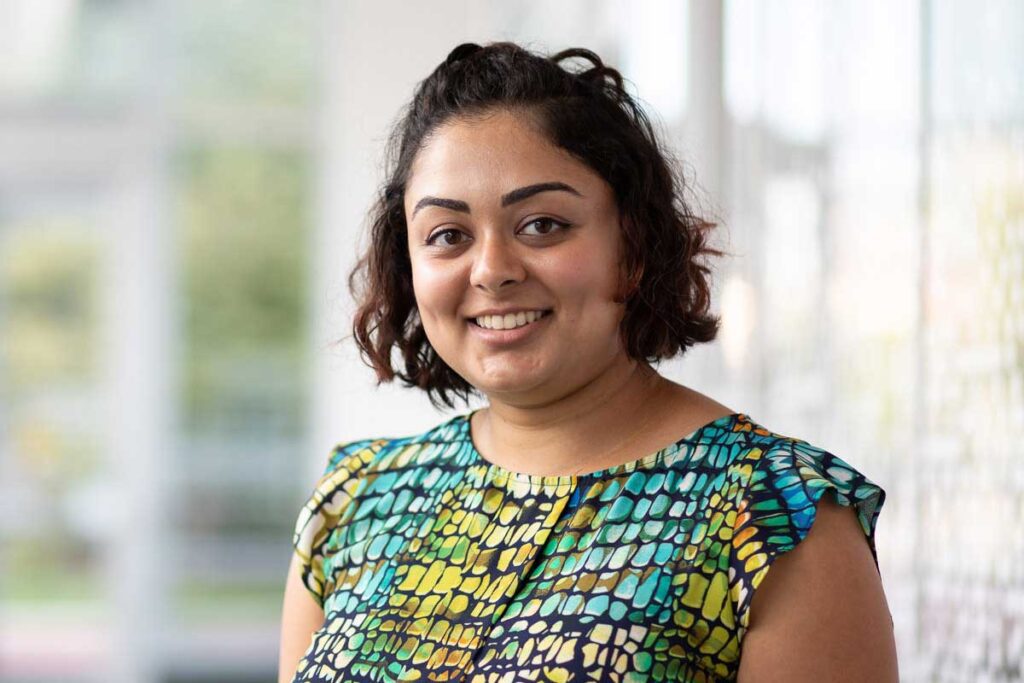
Growing up in the shadow of Silicon Valley means East Bay Area students often develop an early interest in computer science, and while some become involved in community issues, these two areas of interest are not always given a chance to intersect.
Over the summer, the inaugural Coding for our Community program, led by Khoury Associate Teaching Professor Rasika Bhalerao of the Oakland campus, aimed to combine ethical tech with students’ passion for their communities. Over four weeks, Bhalerao guided seven high school students through a civic-minded CS curriculum, covering topics such as data privacy and AI ethics as well as traditional subjects like web applications and game engines.
“There weren’t any students that needed to be enticed into joining computer science. That’s not a need here, but what is needed is a change in the way people see computer science because it doesn’t have a reputation as being community focused,” Bhalerao says.
Students developed technical final projects that were oriented to serve the community in some way. One student built an application for wheelchair users called Bay Area Access, which maps wheelchair accessibility at local businesses — a feature that is often inadequate on Google Maps. Another created a study app to utilize the broad knowledge of large language models while limiting their tendency to over-assist students and short-circuit their learning.
The hyper-competitive nature of Silicon Valley has turned Bay Area high schools into a testing ground for future thought-leaders and innovators, but the type of fervent ambition these environments foster can lead to a myopic view of success. Bhalerao hoped her program might broaden the minds of future developers and open them up to more conscientious paths.
To help change that reputation, Bhalerao is getting students from all backgrounds involved with the field, and that means removing certain barriers to entry. With that in mind, the program was free and open to students without prior programming experience or access to personal computers. It was designed to get students up to speed quickly and enable them to create a final project they could be proud of.
Kylah Kao, a senior at American High School in nearby Fremont, studied AI bias in hiring. She created an app called Auditly, which analyzes resumes and gives them a hiring score similarly to how a hiring algorithm would. This can help applicants evaluate their resumes and reveal the ways that AI models replicate or even worsen human biases. For example, some AI models show bias against hiring women, so including membership in the Society of Women Engineers might cause those models to give the resume a lower score.
Kao discovered these alarming results by auditing bias in LLM-based resume screening across four open models using thousands of prompts. Kao found that even models that are supposedly better at reasoning were not any less biased.
These findings and the Coding for our Community program have motivated Kao to pursue a more impact-oriented direction within tech.
“So often computer science is taught purely through abstract logic problems,” Kao says. “This program stood out because it asked a much more compelling question: How can code solve real-world problems?”
Bhavya Gondra, a senior at Irvington High School in Fremont, created a mental health app called Stellara with a night-sky-themed interface which creates constellations based on the moods of a user’s journal entries. The visualization was meant to incentivize users to journal consistently while helping them understand trends in their thoughts and emotions. The app also provides meditation exercises, as well as an AI chatbot to interpret journal entries and offer personalized support.
“I got to learn about the environmental effects and negative aspects of AI, so I am more aware of how it works and the effects it has on the world while also learning the positive aspects of it and how to apply it in my daily life,” Gondra says.
Both Kao and Gondra say their favorite topic was AI ethics.
“This program changed the way I view computer science because I now understand how AI works and I know how to create things like agents, which I previously didn’t really understand at all,” Gondra says. “I now understand that AI can be a very beneficial tool to aid in many aspects of our lives, including our health.”
“Computer science has become a social process,” Kao adds. “There is a myth of the ‘lone genius,’ but code is not built by one person alone. Having feedback from so many amazing people here at Northeastern like Professor Bhalerao and fellow camp members really helps highlight the process where open-source software, peer review, and ideas are made.”
While AI is upending traditional ideas about computer science education and the tech job market, Bhalerao says it’s forcing educators to reconsider the focus of computing education.
“My philosophy is that training people to do one specific job is risky,” she explains. “For years we got away with training people only to do software engineering. Other departments were focusing on transferable skills, on building a person who is ethical and thinks for themselves and does critical thinking and all these other things. I think we are now being forced to train people not just to be software engineers, but to become well-rounded people and functioning members of society.”
After a successful pilot program, Bhalerao hopes to grow the program next summer and continue to expose aspiring developers to all that computer science has to offer.
The Khoury Network: Be in the know
Subscribe now to our monthly newsletter for the latest stories and achievements of our students and faculty